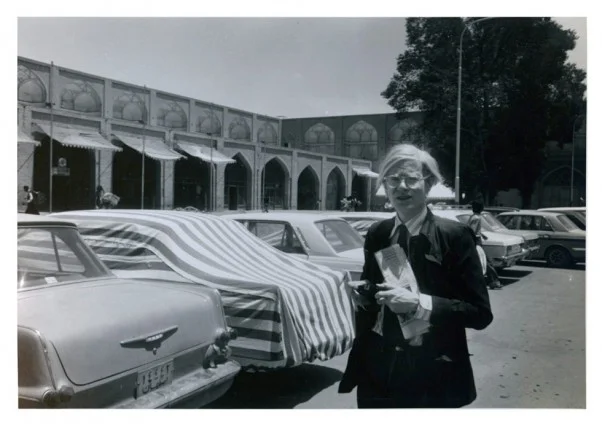
Longtime Vanity Fair contributor Bob Colacello has said he was the Andy Warhol biographer who knew Warhol for more than 15 minutes. He was editor of Warhol's Interview magazine from 1971 to 1983, and became actively involved in all aspects of life — business and social — at The Factory, Warhol’s studio, including procuring celebrity clients for Warhol's famous silkscreened portraits. Colacello's book, Holy Terror: Andy Warhol Close Up, came out in 1990.
In 1976, Colacello traveled to Iran with Warhol, and tonight at Asia Society New York, Colacello will appear in a panel discussion on Iran's art scene in the 1960s and 70s. If you can't attend the event, you can watch the free live webcast starting at 6:30 p.m. New York time at AsiaSociety.org/Live. (UPDATE: A clip from that panel discussion is embedded below; the complete video is available here.)
Colacello, who lives on New York's Upper East Side, talked to Asia Blog by phone.
First, can you describe what brought about your trip to Iran with Andy?
Well, it happened because we had gotten to know the Iranian ambassador to the United Nations,Fereydoon Hoveyda, and he actually arranged for Andy to do a portrait of the Shabanu, or the Empress,Farah Pahlavi. So the purpose of the trip was basically for Andy to take polaroids of her, which then would be made into portraits.
What was your general impression of Iran at that time before you went?
I think my impression of Iran was different than the general impression of Iran. I was criticized for running an interview with the Empress in Interview magazine. Andy's politics were, you know, he was a democrat, but he also was fascinated by world leaders. He had already done the portraits of Golda Meir and Willy Brandt of Germany. We were trying very hard to get Imelda Marcos to commission portraits because we thought she would get thousands done for every post office in the Philippines.
When we went [to Iran], it was obvious that while you probably couldn't stand on a street corner and denounce the Shah, Iran seemed to be a rather free society. Particularly women were free. Tehran, anyway, seemed to be a largely westernized city, or modernized city, I should say, because you definitely felt you were in the Middle East — prosperous, thriving, and growing. So many of the people we met — admittedly we met mostly the upper classes — were Christians, Jews and Baha'is, all of whom were forced out or killed when the Ayatollahs came in. I mean, my point of view on Iran is coming from a different place than I think a lot of others.
Were you surprised by anything you saw there?
I was surprised to the degree of how open the society was and modern. And, you know, on the superficial level, the life in the northern part of Iran then was rather enchanted because these people were successful and making money.
We went to a polo match. We went to a state dinner that the brother of Fereydoun Hoveyda, who was the prime minister, Amir Abbas Hoveyda — it just happened while we were there — he had a state dinner for Prime Minister Zulfikar Ali Bhutto of Pakistan. And that was fascinating, but still kind of haunting. I remember the toast Bhutto and Hoveyda made to each other about the eternal friendship of Pakistan and Iran, and both of those men were gone in a couple years time. Hoveyda assassinated by the Ayatollahs and Bhutto executed by the Pakistani generals.
We went one day to the souq, or bazaar, which was in southern Tehran and there were a few women in chadors. We went to Isfahan and there were a few more people in chadors, but everything was totally peaceful, and prosperous and clean. Everything seemed normal and nice. I never heard the word "shiites" in the 10 days we were there.
How did you describe what you saw in Iran to your friends?
It reminded me of Beverly Hills, except that they had Persian carpets by their pools. Caviar was plentiful, as it was in the Iranian Embassy in the U.S. Hoveyda ran the most sophisticated embassy in New York in terms of the social life because he had been a film critic for Cahiers du cinéma in Paris. So he would give dinners forFrançois Truffaut, Rudolf Nureyev — many cultural figures — people like Lena Horne and Sidney Lumet. I remember one of the first times I met Rupert Murdoch was at a dinner there. It'd be a mix of diplomats, business people, socialites, entertainment people, artists. I mean his parties were great — they were really interesting.
What did Andy think of Iran?
Well, Andy was like, "Oh gee, oh wow, how glamorous." He loved the fact that we could call room service at the Hilton Hotel and get caviar all day long for $10 an order. We met Barry Goldwater in the lobby of the Hilton. Again, Andy's politics are different. I was republican and Andy was a democrat — we would kind of tease each other about it. Barry Goldwater, I remember we thought he was so good looking. He had the white hair. He was wearing a white suit with a black bolo tie, white shirt. He came over and introduced himself to Andy, which was sort of remarkable because the press always portrayed Barry Goldwater as this ultra right-winger, this John Bircher, and they always left out the part that his family was half Jewish and they work in the retail business, which would spoil the John Bircher label people tried to pin on him.
All in all, we had a good time. It was the summertime and the heat was a little much for Andy. Not in northern Tehran which was sort of in the foothills of the mountains, so it was cooler there. But when we went to Isfahan we were dazzled by the beauty of the city, of course, but it was so hot that Andy just couldn't really take it. We had to cancel our planned visit to Shiraz the following day.
We had a great time. The food was fabulous and, you know, the Iranian people are sort of like Mediterranean people — very hospitable, very warm, and tolerant, and embracing.
When you told your friends in New York you were traveling to Iran, what kind of reactions did you get?
The more doctrinaire liberals or leftists didn't approve if the idea. But there was a lot of business between the U.S. and Iran. The Hilton Hotel was packed with Americans, and French, and Germans, and British. It wasn't that unusual to go. Don't forget the Iranian embassy in New York was the leading embassy on a social level. I mean we met the Chinese ambassador and we didn't even have relations with China then. Hoyveda would often bring five or six ambassadors from the U.N. from different countries to lunch at The Factory.
What did you think about the the art scene in Iran?
We really weren't taken to any galleries or artist studios. But in the New York art world there was a sense that, or definitely knowledge that, the Empress was building this museum and buying lots of paintings.
The funny thing about Andy is that he wasn't, we didn't really see that many artists. Again, we were criticized for this, but we saw a lot more sort of society people. Andy was really selling a lot of these commissioned portraits and that was basically what was supporting Interview magazine and allowing Andy to have a staff of 20 people working on his various creative projects.
So, if art wasn't necessarily part of the itinerary, what did Andy like to do while traveling in a country like Iran?
I have to tell you, Andy liked to stay in his hotel room and call New York, order room service. He basically waited for Fred Hughes, his manager, or me to tell him what to do.
I mean, we went to Mexico, for example, in 1972. We went to see the pyramids outside of Mexico City. Andy refused to get out of the car. He said, "Oh, they're just a pile of old rocks." Andy, it seemed me, did not want to contaminate his pop vision with too much history.
But he knew his art history. He pretended he didn't for the press and the general public, because it was all part of his pop image, you know, playing it dumb, but he wasn't. I mean I think Fred and I wanted to go to Isfahan and Shiraz more than Andy did, but that's not to say that was just because it was Iran. He would be the same way in Paris or Rome. He basically wanted to, he liked to go to fancy restaurants and he wanted to make money. He basically considered them business trips and the idea was to sell as much art as possible. So most of our time was spent with rich collectors.
Also because of Interview we saw a lot of people in fashion, a lot of models. Andy loved that whole world, and movie people and celebrities and all of that was part of what Interview covered. So it all kind of fit together.
How did people react to Andy in Iran?
The people we saw, again were mostly the sophisticated slice of society. They were people who had spent time in America and Europe on a regular basis, so they knew who Andy was. I mean walking in the streets, Andy was strange looking with his white wig and his pallor, but that could happen anywhere. I think people treated Andy with a kind of respect and curiosity. They wanted to meet him.
Andy always gravitated towards the younger people. He'd take pictures and have his tape recorder and chat them up. So that was pretty much the same, and most of the younger people were in their 20s, had gone to college in Washington or Los Angeles or New York, so they didn't seem that different from American kids. That age, and that whole generation loved the idea of Andy Warhol and it was the disco era, you know? If anything, people asked us things like, "What is Studio 54 like?" or "Can you get me into Studio 54 when I come to New York in the fall?"
Was there any fallout after you returned from the trip?
The trip wasn't really publicized. This was a private trip. But among friends, among people in the art world, there was this constant back and forth. On one hand all these artists wanted to sell stuff to the Iranians — they wanted to make money. Andy wasn't the only one. On the other hand, their politics were on the liberal side. So I think they were torn.
Did you get the feeling you were there for a unique moment in Iran’s history?
Yeah, I think we were there at a time that, kind of looking back, was a golden age for Iran. And seeing theIran Modern show I realized all the more what kind of creative energy that was there, that there was fantastic work being done dealing with this balance between the West and the East and between traditional culture and modernization and globalization. Globalization wasn't so much a word then, but this is something the whole world is trying to deal with. How do you retain your traditions and history while at the same time being part of this global internet website world? And I think it was wonderful moment in Iran. I'm glad I was there to see it. I would love to go back. The Iranian people are wonderful, and Persian culture is incredible.
This interview was edited for length.